They Never Got Sick. They Never Took Medications. And Their DNA Couldn’t Explain Why.
In 2007, a cardiologist named Eric Topol launched one of the most unusual medical studies in modern history.
He wasn’t looking for sick people. He wasn’t studying disease. He was looking for people who — despite every statistical expectation — had never gotten sick at all.
His team at the Scripps Research Translational Institute set out to find Americans over the age of 80 who had never developed cancer, heart disease, or neurodegenerative conditions like Alzheimer’s. No chronic illness. No chronic medications. Just decades of uninterrupted health in a country where 95% of people over 60 have at least one chronic disease.
He called them the “Wellderly” — the well elderly.
And what he found over the next two decades challenged nearly everything the medical establishment assumes about aging, genetics, and why some people thrive while others slowly decline.
Finding Them Was the Hardest Part
Here’s a detail that should make you pause: the hardest part of the study wasn’t analyzing data. It was finding the participants.
Healthy 80-year-olds don’t show up in hospitals. They don’t sit in waiting rooms. They don’t appear in medical research databases, because those databases are built around disease. Topol’s own daughter, Sarah, drove to retirement communities across Southern California, recruiting people one conversation at a time. Others heard about the study through word of mouth from across the country.
Over the years, the team enrolled more than 1,400 people ranging in age from 80 to 105 — all of whom had reached advanced age without developing any of the major chronic diseases that define modern medicine’s biggest challenges.
These were not just “lucky” people. Many of them had terrible family histories. One participant, Lea Rosenberry, was 98 years old and in perfect health. Her parents had died in their 50s and 60s. Her brothers died in their 60s. By every family-history-based prediction model, she should have been gone decades ago.
And yet there she was. Perfectly healthy. No medications.
The Stunning Result: It Wasn’t in Their DNA
This is where the story gets truly interesting — and where it becomes directly relevant to you.
Topol’s team performed whole-genome sequencing on all 1,400+ participants. This isn’t a basic genetic test. This is the most comprehensive analysis of someone’s entire DNA that science can perform.
They expected to find a “silver bullet” — a genetic variant or cluster of variants that explained why these people had been spared from disease.
They didn’t find one.
As Topol described it, the result was stunning. While there were some small differences — particularly a slightly lower genetic risk for Alzheimer’s disease and coronary artery disease — there was no clear genetic advantage across the board. No longevity gene. No secret DNA sequence. No protective mutation that the rest of us are missing.
The Wellderly carried the same disease-risk genes that the rest of the population carries. They simply never expressed them.
So What Was Different?
If genetics wasn’t the dominant story, what was?
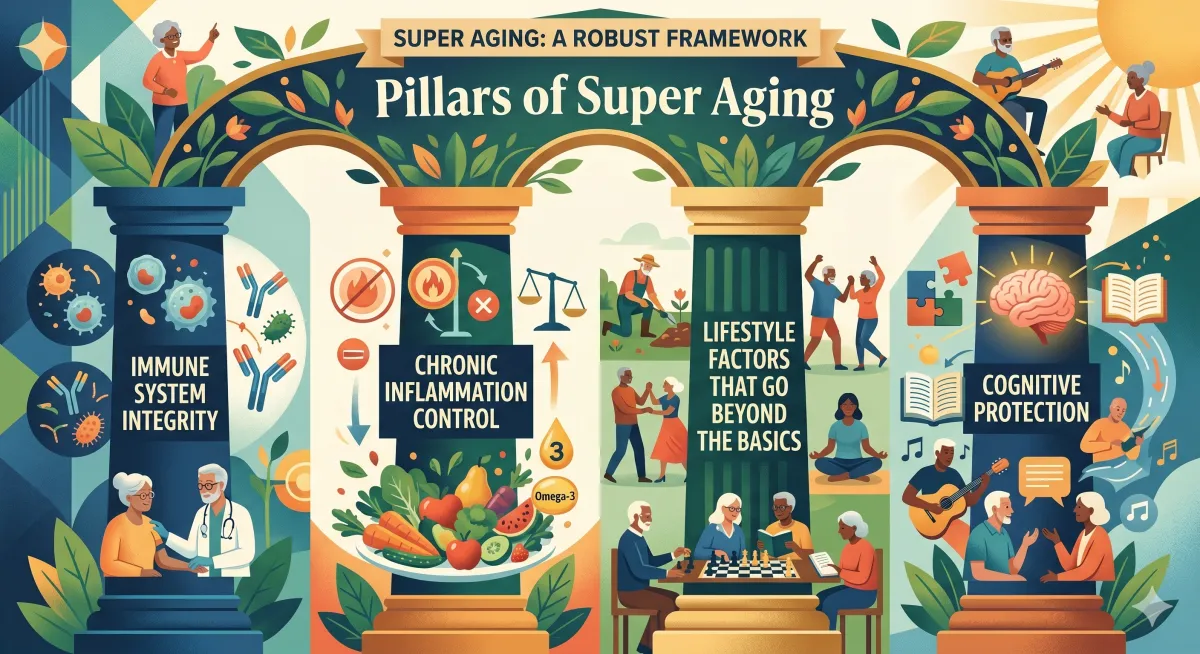
Topol’s conclusion — supported by nearly two decades of follow-up data and published in the journal Cell — points to a web of factors that, collectively, seem to protect certain people from the cascade of chronic disease that derails most of us:
Immune system integrity. This is Topol’s number one bet. The Wellderly appeared to maintain an immune system that functioned as though it were decades younger. In most of us, immune function degrades as we age — a process called immunosenescence. Our ability to fight cancer cells, manage inflammation, and respond to infections slowly erodes. But in these individuals, that erosion hadn’t happened in the same way.
Chronic inflammation control. Inflammation is the common thread connecting nearly every age-related disease — heart disease, cancer, diabetes, Alzheimer’s. The Wellderly appeared to maintain lower levels of systemic inflammation, which likely protected them from the cascade that turns normal aging into disease.
Lifestyle factors that go beyond the basics. Topol’s research confirmed what we know about exercise, nutrition, and sleep — but also expanded the definition to include factors that most doctors never discuss: social connection, environmental exposures, purpose, and socioeconomic conditions. He calls this “lifestyle+” because the picture is far broader than “eat clean and exercise.”
Cognitive protection. One of the study’s most intriguing findings was that the Wellderly had a higher-than-normal presence of genetic variants offering protection specifically against cognitive decline. This suggests a possible link between long-term brain health and protection from chronic diseases more broadly — as if keeping the brain healthy creates a downstream protective effect on the entire body.
Why This Matters If You’re a High-Performing Man Over 40
Here’s what I want you to take from this.
The conventional medical model is built around finding disease after it’s already started. We wait for symptoms. We run standard labs. We treat what we find. And if nothing shows up on a basic panel, we say “you’re fine.”
But the Wellderly study tells us something different. It tells us that the people who age the best aren’t doing so because they won some genetic lottery. They’re doing so because the systems that regulate their health — their immune function, their inflammation levels, their brain chemistry, their gut integrity — are functioning optimally.
And those systems can be measured. They can be optimized. They can be protected.
As a cardiologist and electrophysiologist who has spent over a decade seeing what happens when chronic disease catches up to high-performing men, this research reinforces what I see every day: the men who stay sharp, energetic, and resilient into their 50s, 60s, and beyond are not the ones with the “best genes.” They’re the ones who addressed the root-cause drivers before the damage was done.
Coming Next: The Five Pillars of Super Aging
In Part 2 of this series, I’ll break down Topol’s New York Times bestseller, Super Agers: An Evidence-Based Approach to Longevity, and the five-pillar framework he uses to separate real longevity science from the pseudoscience, biohacking hype, and supplement marketing that dominates the conversation.
About the Author
Dr. Arvindh Kanagasundram is a board-certified cardiologist and cardiac electrophysiologist at Vanderbilt University Medical Center and co-founder of Functional Core MD, a root-cause health optimization practice for high-performing men. Learn more at functionalcoremd.com.
Disclaimer: This content is for educational purposes only and is not intended to diagnose, treat, cure, or prevent any disease. Always consult with a qualified healthcare provider before making changes to your health regimen.
