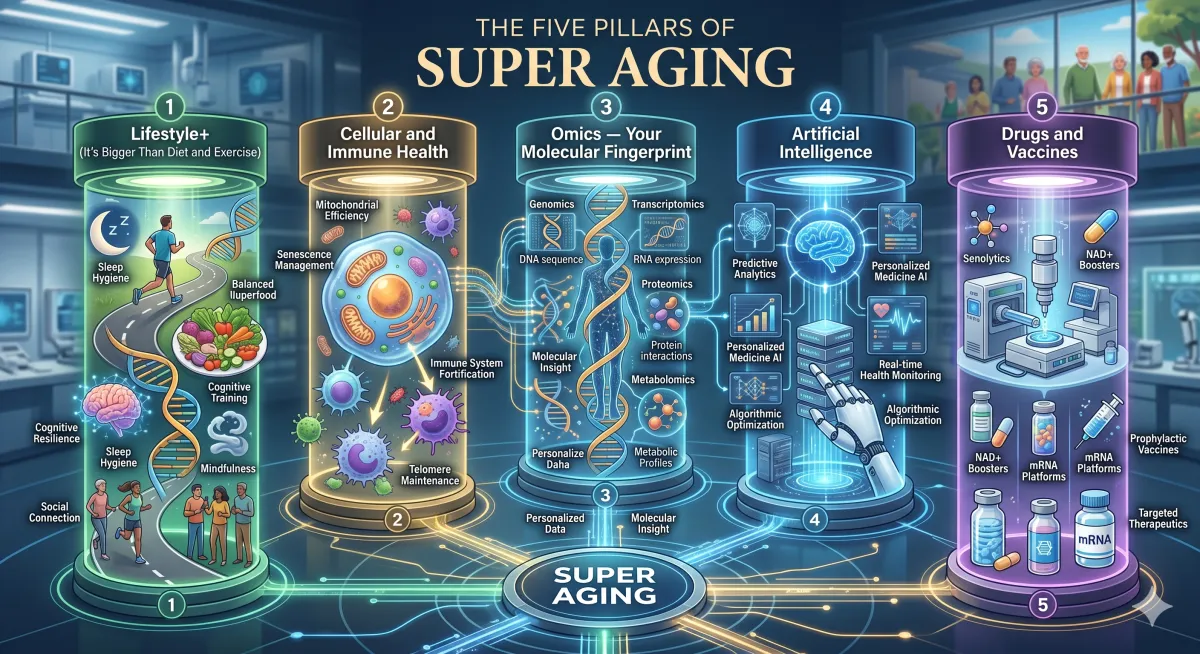
The Five Pillars of Super Aging
In Part 1 of this series, I covered Eric Topol’s remarkable Wellderly study — the nearly 20-year investigation into more than 1,400 people who reached their 80s and beyond without ever developing cancer, heart disease, or neurodegenerative decline. The conclusion was startling: their DNA couldn’t explain it.
Now, in his New York Times bestselling book Super Agers: An Evidence-Based Approach to Longevity, Topol takes the next logical step. If it’s not purely genetic, what is driving healthy aging — and what can the rest of us actually do about it?
As a fellow cardiologist, I’ll be honest: I’ve read a lot of longevity books. Most of them amount to some variation of “sleep more, stress less, take these supplements.” Topol’s contribution is different. He’s one of the top 10 most cited researchers in medicine, with over 1,300 peer-reviewed publications. He’s not selling a protocol or a supplement line. He’s synthesizing what the evidence actually says — over 1,800 citations — and calling out what it doesn’t.
Here’s what I think every high-performing man over 40 needs to understand from this book.
Pillar 1: Lifestyle+ (It’s Bigger Than Diet and Exercise)
Topol uses the term “lifestyle+” deliberately. Yes, the data overwhelmingly supports the foundational trio — nutrition, exercise, and sleep. Three large prospective studies following more than 200,000 people over 32 years consistently showed that healthy eating alone was associated with a 15 to 20 percent lower cardiovascular risk. The dose relationship held across cardiovascular disease, cancer, and neurodegenerative disease: the better you eat, the lower your risk.
But Topol expands the frame considerably beyond what most doctors discuss. He argues that any serious conversation about healthy aging must also account for environmental exposures, socioeconomic conditions, social isolation and loneliness, and mental health.
This “lifestyle+” lens resonates deeply with what we see at Functional Core MD. The men we work with are often already eating well, training hard, and tracking their sleep. They’ve checked the conventional boxes. Yet they’re still experiencing brain fog, energy crashes, hormonal decline, and slow recovery. That’s because the conventional checklist is incomplete. Environmental toxin exposure, chronic low-grade inflammation, gut integrity, and social connection are not optional add-ons — they’re core variables.
Pillar 2: Cellular and Immune Health
This is perhaps the most important — and most underappreciated — section of the book.
Topol argues that the health of the immune system may be the single most critical factor in determining who ages well and who doesn’t. He describes it as the body’s “organ clock” — the system whose deterioration most reliably predicts the onset of age-related disease.
In most of us, immune function slowly degrades with age. This process — immunosenescence — means our bodies become progressively less effective at surveilling for cancer cells, managing inflammation, and fighting infections. It’s why cancer incidence rises dramatically after 50. It’s why chronic inflammation quietly accelerates heart disease. It’s why infections that were trivial at 30 become dangerous at 70.
The Wellderly, as a group, appeared to have maintained immune function far beyond what’s expected for their age. And the emerging science Topol describes — including advances in cellular engineering and immunotherapy — suggests we may soon have tools to actively restore and protect immune function rather than simply watching it decline.
For men in their 40s and 50s, the practical implication is clear: the chronic inflammation you’re tolerating right now is not benign. The elevated cortisol, the gut permeability, the environmental toxin load — these are all accelerating immunosenescence. Addressing them isn’t optional if healthy aging is the goal.
Pillar 3: Omics — Your Molecular Fingerprint
“Omics” refers to the massive datasets that genomics, proteomics, and metabolomics generate — essentially, a molecular-level snapshot of who you are and what’s happening inside your body right now.
Topol is a major proponent of tools like polygenic risk scores, which can calculate your personal risk for conditions like coronary artery disease, diabetes, and Alzheimer’s years — sometimes decades — before symptoms appear. This isn’t speculative future technology. These tools exist now and are getting more precise every year.
The broader point is one I make to my own patients regularly: “normal” lab ranges tell you whether you’re currently diseased. They don’t tell you whether you’re on the trajectory toward disease. Omics-level data — combined with advanced functional testing of hormones, neurotransmitters, gut health, and inflammatory markers — paints a picture that standard blood panels simply can’t.
This is the difference between reactive medicine (“your labs look fine, come back in a year”) and predictive, root-cause medicine (“here’s what your data tells us about what’s coming, and here’s what we can do about it now”).
Pillar 4: Artificial Intelligence
AI is the engine that makes personalized medicine scalable. Topol has been writing about this for years — his previous book Deep Medicine was devoted entirely to the subject — and in Super Agers, he makes the case that AI will fundamentally transform how we screen for, predict, and treat age-related disease.
The applications he highlights include AI-powered cancer screening that catches malignancies earlier than any current method, AI-driven drug discovery that’s accelerating the development of new therapeutics at an unprecedented pace, and the ability to take an individual’s entire molecular profile and generate truly personalized prevention strategies.
We’re in the early stages of this transformation, but it’s already reshaping how forward-thinking clinicians approach patient care. In the coming years, the gap between conventional medicine and precision medicine will widen dramatically.
Pillar 5: Drugs and Vaccines
This is where Topol addresses the pharmacological frontier — and where he’s most useful as a counterweight to the hype that dominates the longevity space.
He documents the rise of GLP-1 receptor agonists (the drug class that includes semaglutide) and makes the evidence-based case that their benefits extend well beyond weight loss and diabetes management. The emerging data suggests potential effects on cardiovascular disease, kidney disease, and even neurodegeneration.
But — and this is what makes Topol’s book different from the longevity influencer crowd — he also systematically debunks the pseudoscience. The anti-aging pill promises. The unproven biohacking interventions. The $8,000 supplement protocols that have never been tested in rigorous clinical trials. As Nobel laureate Venki Ramakrishnan put it, Topol “takes on a field full of overblown or premature claims” and separates what we know from what we’re guessing.
For the men I work with — many of whom have already spent thousands on supplements and protocols that didn’t move the needle — this distinction is everything.
The Common Thread: It’s About Healthspan, Not Lifespan
The central argument of Super Agers isn’t about living to 120. It’s about living to 80, 90, or 100 without chronic disease. Topol draws a critical distinction between lifespan (how long you live) and healthspan (how long you live well).
Ninety-five percent of Americans over 60 have at least one chronic disease. That’s the problem this book is trying to solve. Not mortality — morbidity. Not death — decline.
And the answer, as the Wellderly study demonstrated, is not primarily genetic. It’s modifiable. It’s addressable. It’s about understanding the systems that regulate your health — your immune function, your inflammation levels, your hormonal balance, your brain chemistry, your gut integrity — and taking action before those systems fail.
Coming Next: What This Means for You
In Part 3, I’ll bring this closer to home. What does the Super Agers framework actually look like in practice for a high-performing man in his 40s or 50s? What should you be testing that your doctor isn’t? And how does root-cause medicine bridge the gap between where you are now and where the Wellderly were at 80?
About the Author
Dr. Arvindh Kanagasundram is a board-certified cardiologist and cardiac electrophysiologist at Vanderbilt University Medical Center and co-founder of Functional Core MD, a root-cause health optimization practice for high-performing men. Learn more at functionalcoremd.com.
Disclaimer: This content is for educational purposes only and is not intended to diagnose, treat, cure, or prevent any disease. Always consult with a qualified healthcare provider before making changes to your health regimen.
